Drip Line Installation in the Inland Empire
The most water-efficient way to keep your planter beds, trees, and shrubs alive in the Inland Empire heat. We install drip systems that deliver water right where it counts.
The most water-efficient way to keep your planter beds, trees, and shrubs alive in the Inland Empire heat. We install drip systems that deliver water right where it counts.
When water rates keep climbing and summer temperatures push past 100 degrees for months at a time, how you water your landscape matters more than ever. Drip irrigation is the most efficient watering method available, and for planter beds, trees, shrubs, and container plants, it is the only method that makes sense in a climate like ours. At SoCal Artificial Turfs, we install drip systems as part of full landscape builds and as standalone upgrades for existing yards.
Drip irrigation works by delivering water slowly and directly to the root zone of each plant through a network of tubing and emitters. There is no spray, no overspray hitting the sidewalk, no water evaporating in the air before it reaches the ground. The water goes exactly where it needs to go -- into the soil, right at the base of the plant. This means less water waste, healthier roots, and lower water bills.
We use two main types of drip systems depending on the planting layout. For beds with consistent spacing -- like shrub rows along a fence or ground cover beds -- we use inline drip tubing with pre-spaced emitters every 12 or 18 inches. For beds with mixed plantings at irregular spacing -- like a front yard with scattered succulents, a few trees, and ornamental grasses -- we run blank tubing and add individual emitters at each plant location. Both approaches get the job done; we choose based on what will work best for your specific layout.
Every drip system we install includes a pressure regulator (drip runs at much lower pressure than sprinklers), an inline filter to prevent clogging, and a dedicated zone on your irrigation controller. This lets you schedule drip watering separately from your sprinkler zones, which is important because drip runs longer but uses far less water per minute.
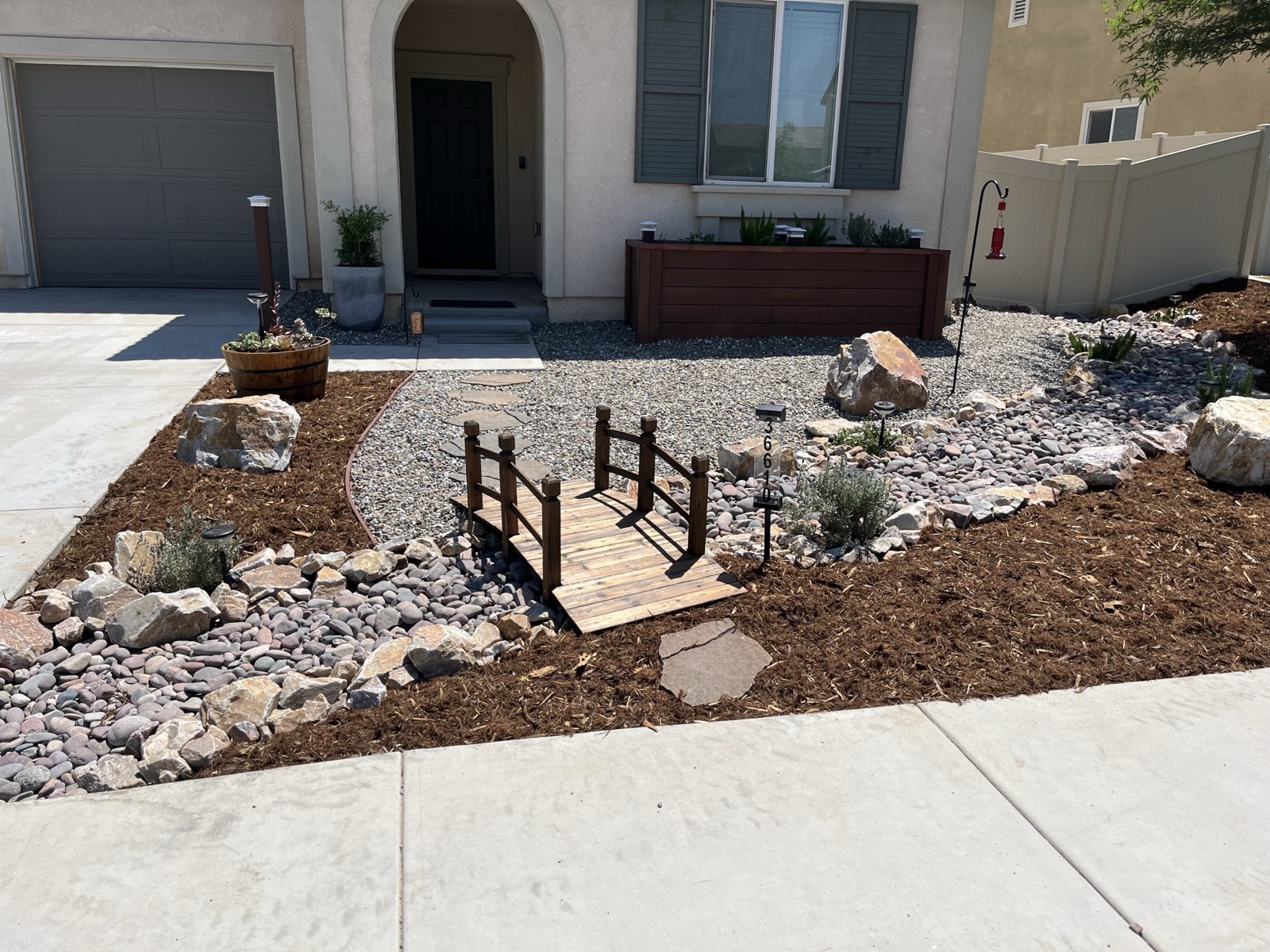
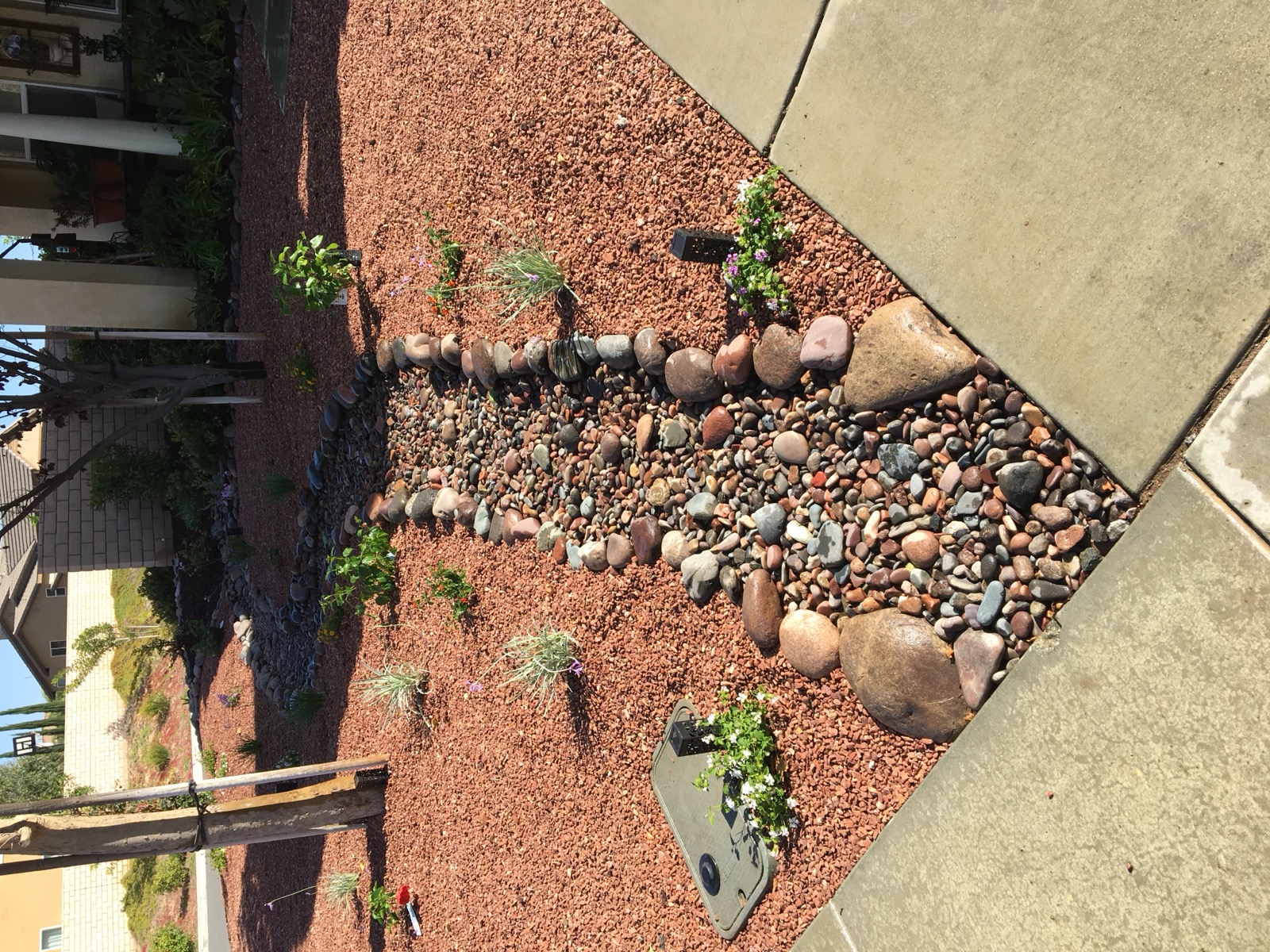
Drip is the perfect companion to bark mulch and decorative rock. The tubing runs underneath the mulch or rock, hidden from view, while the ground cover slows evaporation and extends the benefit of every watering cycle. For homes with artificial turf, drip in the surrounding planter beds is often the only irrigation needed since the turf requires zero water.
Get a Free EstimateDrip delivers water directly to roots with zero overspray, zero runoff, and minimal evaporation. Your plants get more water for every dollar you spend.
Slow, deep watering encourages deep root growth. Plants with deep roots are more drought-tolerant and more resilient during the brutal Inland Empire summers.
Drip tubing runs under mulch or rock, completely out of sight. No pop-up heads to trip over, no spray patterns to dodge when you are in the yard.
Because drip only waters where your plants are, the soil between plants stays dry. Dry soil means fewer weeds germinating in the open spaces of your beds.
We design drip systems for every type of planting situation.
Pre-spaced emitters every 12 or 18 inches. Ideal for evenly spaced shrub beds, ground cover, and rows of plants along fences or walls.
Individual emitters placed at each plant. Best for beds with mixed plantings at irregular spacing, large shrubs, and ornamental trees.
Higher-flow emitters for established trees that need more water at the root zone. We install these on a separate zone from bed drip for proper scheduling.
Micro-tubing and adjustable emitters for patio containers, hanging baskets, and raised planters. Automates watering for pots that dry out fast in the heat.
Sprinklers spray water over a wide area and are best for lawns and large open spaces. Drip irrigation delivers water slowly and directly to the root zone of individual plants through emitters or inline tubing. Drip uses 30% to 50% less water than sprinklers because there is no overspray, no evaporation from the air, and no runoff. It is the most efficient way to water planter beds, trees, shrubs, and containers.
Drip irrigation is ideal for any planted area that is not lawn. That includes shrub beds, flower beds, planter boxes, raised beds, around trees, along fence lines, and for container plants on patios. If you have artificial turf in your yard, drip lines for the surrounding planter beds are often the only irrigation you need since the turf does not require water.
Drip systems are low-maintenance but need occasional attention. We recommend flushing the lines once or twice a year by opening the end caps and letting water run through to clear sediment. Check emitters periodically to make sure they are not clogged. Replace the inline filter annually. And walk the lines after any landscaping work to make sure nothing was accidentally cut or disconnected.
Drip irrigation is one of the most affordable irrigation options. A basic drip system for a few planter beds might cost $500 to $1,500 installed. A full property drip system covering all beds, trees, and planters typically runs $1,500 to $4,000 depending on the number of zones and total linear footage. We include it in your overall estimate when it is part of a landscape project.
We provide drip line installation across the Inland Empire, including San Jacinto, Hemet, Menifee, Temecula, Murrieta, Riverside, Corona, Palm Springs, Beaumont, and Lake Elsinore. Based in San Jacinto, our crew handles projects throughout Riverside County, San Bernardino County, and the western Coachella Valley. View all 40+ cities we serve.